Tuesday, March 27, 2007

Revisiting organismal complexity


Once it was thought to be proportional to the size of the genome. Then, we found that most of the genome of some organisms was apparently doing nothing since it did not code any proteins, so it was postulated that organismal complexity was proportional to the number of genes. Thus, it came as shock that we humans, of all organisms, had a relatively modest number of genes with respect to our intuitive notion of complexity.

Nowadays people talk of the regulatory interactions between genes as the true key to organismal complexity. According to this view, intricate regulation and not sheer number of proteins should reflect the complexity of an organism.

A relatively new player in this mind-game is miRNA. Strong evidence suggests that microRNAs are effectors of an intricate, fine-tuned regulatory network that acts combinatorially on mRNA transcripts. And, according to some estimates, more than half of the coding genes of vertebrates have their expression modulated by microRNAs.

An excellent introduction to this topic can be found here.

And let there be light


Commonly used lab bacteria called E. coli can be converted into light-harvesting organisms in a single genetic step, according to new research from MIT. The genetic enhancement allows microorganisms that normally derive their cellular energy from sugars to switch to a diet of sunlight. These findings could ultimately be used to genetically engineer bacteria that can more efficiently produce biofuels, drugs, and other chemicals.

Read more

Wednesday, March 14, 2007

Another dimension...

Have you heard about this work? It reports the first 3D reconstruction of a complete eukaryotic cell volume, the fission yeast Schizosaccharomyces pombe, by electron tomography. How amazing!


This high-resolution, three-dimensional image of a eukaryotic cell was created by researchers led by Claude Antony of the European Molecular Biology Laboratory in Heidelberg, Germany. They scanned 250-nanometre-thick slices of frozen fission yeast and assembled the scans into a computer-generated 3D image.

Neglected and Orphan Tropical Diseases?!

Last week, in my lab meeting we laughed at the existence of a journal called 'PLoS Neglected Tropical Diseases' which is the first open-access journal devoted to the neglected tropical diseases (NTDs).

So, I was curious, and I tried to find what diseases are charaterized this way. And why! I'm writing this post because I thought this could be a great topic of discussion.

There are 13 tropical diseases considered to be 'neglected', because not enough money is spent on researching and/or distributing cures (e.g., leprosy). I've read that the 13 all have some fundamental traits in common, not in terms of their biology, namely:
  • Ancient afflictions that have burdened humanity for centuries
  • Poverty-promoting conditions
  • Associated with stigma
  • Rural areas of low-income countries and fragile states
  • No commercial markets for products that target these diseases
  • Interventions, when applied, have a history of success

  • But, do you know what I also found interesting? The open-source 'Tropical Disease initiative' also refers to Orphan Diseases (illnesses on which phamaceutical companies tend to do little research)! They argue that there is an overlap between 'neglected' and 'orphan' diseases, but the latter group includes TB and malaria.

    By the way, do you know that some people argue that malaria is
    not a tropical disease? World largest outbreaks of malaria in recent time occured in siberia and norway in the 19th Century!

    Wednesday, February 21, 2007

    The Molecular Biology Database Collection

    This is probably not new for some people. Nevertheless, I found interesting to post a link for a public database collection containing links and a small description of databases mentioned in the database issue of Nucleic Acids Research. This database was released in 2001 and had been regularly updated every year.

    Friday, February 09, 2007

    The inner life of a cell

    Will we ever understand it?

    Wednesday, January 31, 2007

    Don't worry... be happy!

    "Be happy! Feeling unhappy is normal and is good! You are not alone! You are not the only one! Those mixed feelings are part of being a grad student, and learning to deal with them is an important part of your PhD learning process." (Welcome speech by the University Dean to the Grad students)

    And if you don't believe the man, take a look at these "pérolas":

    http://www.phdcomics.com/comics.php

    Cheers, Isabel

    Tuesday, January 23, 2007

    Freezing in Lyon


    It is my second post (first non-latin) here, so I thought I should (re-)start with something light.

    After some weeks worrying about bureaucracy, trips to IKEA and calling the Utilities companies asking for a monthly bill (rather than an annual or semi-annual one which is, so it seems, the default procedure in France) I finally started working on my PhD project.

    It is snowing in Lyon, which is something I wished to share with all of you - it's pretty! (I would take a picture myself but it is already too dark for that - the photo on this post is from last year).

    I've been reading some exciting new articles on miRNA which I will post here as soon as I have read them all (it may take some time - be warned) but yesterday I came across an interesting piece of news here and I would like to hear your thoughts on the matter.

    And I should also give you the link to my latest paper (comments are more than welcomed).

    Sunday, January 21, 2007

    The IUPAC International Chemical Identifier

    Dear all,

    I found inevitable to post about this paper. Though I know that for some of you this will not change a thing in the research project, the paper reports a big change for the ones o work more close with metabolism.
    The representation of chemical compounds has been a big issue for Chemists and Biologists. Biologists in particular have found an increasing difficulty dealing with the amount of metabolites as metabolic networks grow in complexity (see link).

    In order to explain this issue I will give you a small example. Go to KEGG database and do a search for glucose. This does not seem strange because glucose can assume different forms and so different names, but just take a careful look in the second hit. Well, I know that grapes are sweet but not so sweet to have their own sugar. I am sure that this funny example does not represent a problem for Biochemists but imagine if you find in your database a compound with so many names that you decide to check this compound in other database like, let us say BioCyc. Ups... Now I am confused. What is really the name of the compound? Is this the same compound that I was looking for? Well, better days will come before I finish my accurate metabolic network with 500 metabolites.

    Taking some of these problems in account, IUPAC launched in 2001 a project to develop a nomenclature for representing the chemical structure of organic molecules in a unique digital string. A test version of the International Chemical Identifier (InChI) was released in March 2002 and three years later the first version of the InChI software was released. In August 2006 an update version was released along with a validation protocol to check the validity of the output and we can start finding this nomenclature in numerous databases as NIH/NCI, NIH/PubChem, Thomsom/ISI and MDL/Elsevier, as well as search compounds with this nomenclature in Google.

    This nomenclature is still in his infancy and let us see what changes it will bring in Chemistry and in Biology.

    Lui­s Figueiredo


    P.S. - Thanks for the tip Mr. Correia :P


    Saturday, January 20, 2007

    ISMB/ECCB 2007

    Hi

    Many of you may know already, but is never to much to remind it:

    Intelligent Systems in Molecular Biology and European Conference in Computational Biology 2007. It's going to be in Austria in July, it looks like a very good conference to attend and besides that could be a good meeting point...

    bruno

    Saturday, January 13, 2007

    Yes, It's me again!!!

    Hi,

    I have just arrived in Boston and just wanted to say hello! Should anyone happens to be in the neighborhood, just drop by!
    Bye,

    Candeias

    Friday, January 05, 2007

    Why do we live in a computer simulation?

    After sleepless nights, wondering about the meaning of live and of the lyrics of Dino Meira, consequently I took the most logical steep and GoogleIt!
    Enjoy and maybe the question does even make sense.

    Me, Myself and My Ego

    PS. - The title was actually a link, so now it is here: http://www.simulation-argument.com/simulation.html

    Friday, December 01, 2006

    Top 25 science books of all-time!

    DISCOVER states the essential reading list for anyone interested in science. Darwin, Newton, Galileo, Copernicus, Einstein, Watson and Schroedinger are some of the authors represented.

    Have a look on the website!

    Friday, November 17, 2006

    (Attempted)Tree of life based on protein structure

    Hi

    I would like to post this paper for several different reasons:

    - Interesting for genomics people and as well to people interested in protein structure

    - Uses simple methods to assess very complicated and controversial questions

    - Uncovers curious facts like: a set of 50 protein folds are common to the three superkindgoms of life

    Here goes the link:

    http://www.pnas.org/cgi/content/full/102/2/373


    I hoppe you enjoy it...

    bruno

    P.S. If you have the chance to read the paper, it is likely that you will not agree with my opinion (that it is a good paper to read). If you don't, say why and I'll be happy to reconsider it...
    In the other hand, if you liked it you can always say what you liked the most...

    Sunday, November 12, 2006

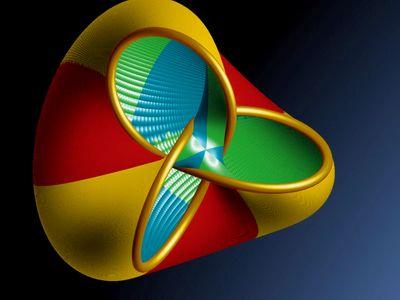
    Amazing Math


    A collaboration between a mathematician and an artist-geometer has resulted in some of the most mathematically sophisticated and aesthetically gripping animations ever seen in the field. Their visualizations of cutting-edge research in dynamical systems theory not only provide a dramatic new way of visiting mathematical worlds once seen only in the mind's eye, but also point to a new era for the use of computer graphics in communicating and carrying out mathematical research. Personally, I found that these animations about research in dynamical systems theory are absolutely astonishing.

    The two collaborators are Etienne Ghys, a mathematician at the Ecole Normale Superieure in Lyon, France, and Jos Leys, a Belgian graphic artist and engineer with strong mathematical interests.

    Here is a link to the paper ('Lorenz and modular flows: a visual introduction'), which contains links to absolutely stunning animations in QuickTime format. Don't miss it!

    Monday, October 30, 2006

    E tu, já fazes parte da Equipa?

    Depois de esfolhear a revista Exame Informática, uma revista que à partida de científico tem pouco, deparei-me com este artigo interessante.

    Exame Informática, N. 137, Novembro 2006
    A primeira questão que me veio à cabeça após ler este artigo e que me anda a atormentar já desde a apresentação do Bruno sobre o seu projecto de doutoramento é,

    " Quantos de nós, futuros Doutorados em Biologia Computacional, já aderimos a este projecto?"

    Wednesday, October 04, 2006

    Genomics and Proteomics

    For the one's that will work on Genomics and/or Proteomics, or simply seeking some insight on these issues, this is a free magazine that usually presents good schematics and simple to follow articles on recent developments in the area.

    http://www.genpromag.com/

    Wednesday, September 20, 2006

    In principio erat verbum